
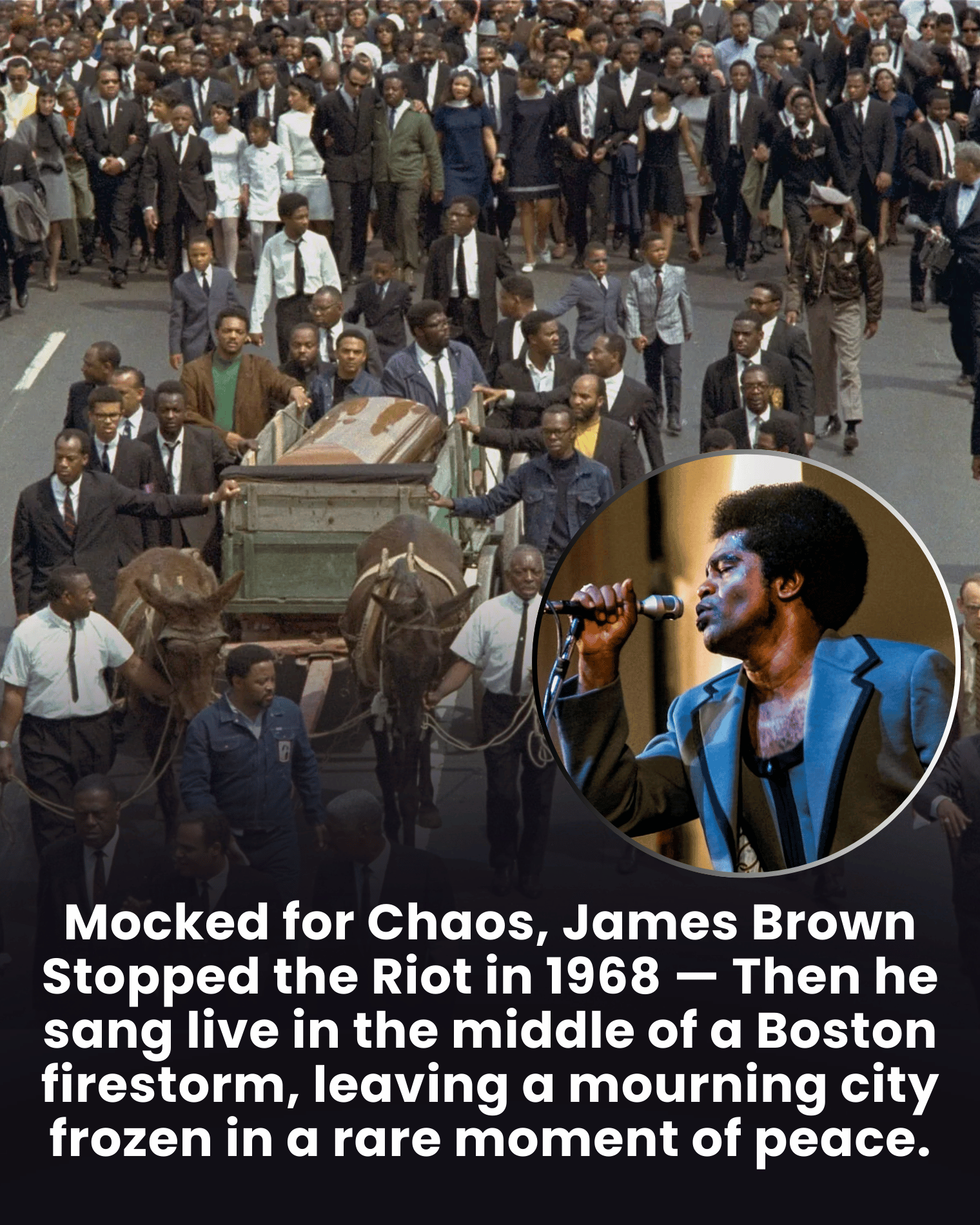
On April 5, 1968, the United States was gripped by grief and anger following the assassination of Dr. Martin Luther King Jr. The night after the civil rights leader's death, cities across the country erupted in protests, unrest, and violence. Fires burned in dozens of urban neighborhoods, and the nation seemed to be teetering on the edge of chaos. In Boston, city officials feared that the tension could explode into a full-scale riot.
That same night, James Brown—already known as the "Godfather of Soul"—was scheduled to perform a concert at the Boston Garden. As the situation worsened across the country, many local leaders considered canceling the show. They worried that bringing thousands of young people together in one arena might ignite further unrest.
But Brown saw things differently.
Instead of canceling the performance, he insisted that the show go on. Boston's mayor, Kevin White, agreed on one condition: the concert would be broadcast live on local television. The idea was simple but bold—if people stayed home to watch the concert, it might keep the streets calmer during one of the most volatile nights in American history.
What happened next would become one of the most remarkable moments in the intersection of music and social history.
As James Brown took the stage, the atmosphere inside the Boston Garden was electric but tense. The audience understood the gravity of the moment. Outside the arena, the country was in turmoil. Inside, the crowd was searching for something—perhaps release, perhaps comfort, perhaps leadership.
Brown delivered exactly what they needed.
With his band behind him, he launched into a series of explosive performances that showcased the energy and precision that had made him one of the greatest live entertainers in the world. His powerful voice and relentless rhythm filled the arena, transforming the heavy mood into something more focused and hopeful.
Then, midway through the concert, the tension nearly erupted.
A group of young fans climbed onto the stage, eager to dance alongside Brown. Police officers quickly moved in to push them back, worried that the situation might spiral out of control. For a moment, it seemed possible that the confrontation could trigger exactly the kind of chaos the city feared.
James Brown reacted instantly.
He stopped the music.
Walking toward the front of the stage, he addressed the crowd directly, speaking calmly but firmly. He told the police to step back and allow him to handle the situation himself. Then he turned to the young fans and reminded them of the importance of dignity and pride.
"Don't make me look bad," he told them. "I'm black and proud."
His message was simple but powerful. He urged the crowd to represent themselves—and their community—with respect and discipline during a moment when emotions were running dangerously high.
The effect was immediate.
The fans stepped down from the stage, the tension dissolved, and the concert resumed. Brown launched back into his set with renewed energy, turning the performance into a celebration of unity rather than a flashpoint for anger.
Meanwhile, thousands of people across Boston watched the broadcast from their homes. Instead of gathering in the streets, they tuned in to witness a concert that would become legendary.
By the end of the night, Boston remained largely peaceful while many other cities across the United States continued to experience violence and destruction. Historians and civic leaders later credited James Brown's performance—and the decision to broadcast it live—with helping calm the city during one of the most volatile moments in American history.
For those who were there, the memory remains unforgettable. In a time of mourning and fear, James Brown used the authority of his voice and the power of his music to guide a crowd toward restraint.
It was more than a concert. It was a moment when a performer became a leader, and when soul music helped bring a city back from the brink.